The strange loop is how IQ learns from itself.
In cognitive systems, the strange loop is operational: IQ models its own state, workload, resources, and outcomes, then uses that feedback to adapt its decisions.
IQ does not just model your world. It models itself acting inside it.
IQ can observe what it is doing, what is constrained, what is changing, and what follows from it's actions.
IQ tracks workload, memory pressure, model availability, queue depth, and execution state. It uses that feedback to adjust priorities, routing, and strategy — rather than treating every request as an isolated event.
Observe. Understand. Prioritise. Adapt.
The loop is valuable because it creates a closed decision cycle: the system sees what it is doing, evaluates the constraints it is operating under, changes its behavior, and learns from the outcome.
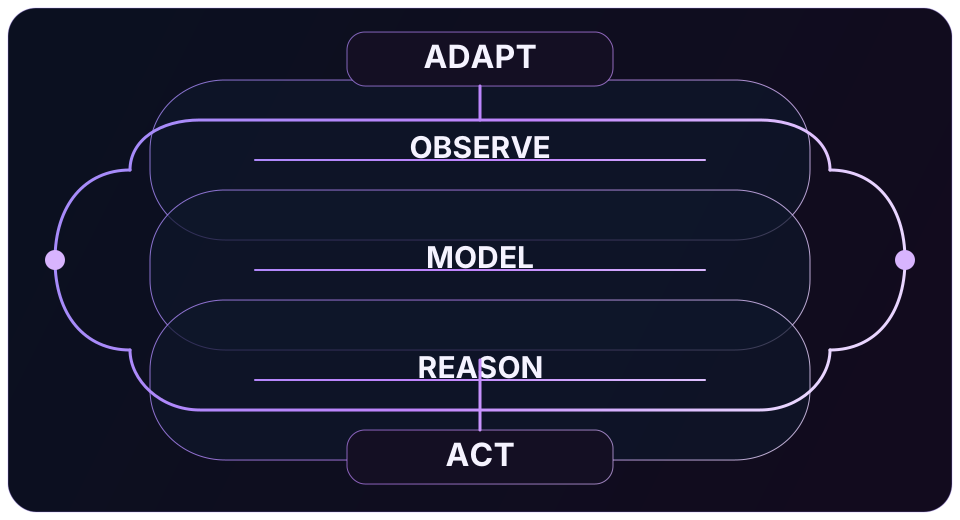
A live model sees new observations, updates your world state, reasons over consequences, and decides on the next action. That action changes the environment, which generates new observations, which changes the next decision.
In other words: the system learns from its own execution path, not just its inputs.
IQ does not just model the workload. It models the operating conditions around that workload.
It tracks compute, memory pressure, queue depth, model availability, latency, and execution state. Those are not metadata. They are decision variables.
When a query becomes expensive, a node goes offline, or a GPU becomes saturated, the system can change its route, reschedule work, defer low-priority actions, and choose a different model or execution path.
A new agent arrives. A model becomes available. Memory pressure increases. The system adapts.
This is the value of the strange loop in cognitive computing terms: the system is not merely observing your world; it is using its internal model of itself and its executing environment to make better decisions in real time.
That creates higher-quality routing, better resource allocation, less wasted compute, and more resilient behavior under uncertainty.
Observe → reason → adapt → execute → observe again.
♾️ IQ adapts to your world ♾️
♾️ your world adapts to IQ ♾️
♾️ IQ adapts to your world ♾️
Queries, jobs, inference, memory operations and background work can respond to the conditions of IQ rather than blindly competing for resources.
Agents operate against a living world model and can change strategy as context, evidence, workload and available resources change.
The system can change how it resolves and prioritises work according to what is known, what is changing, and what IQ can efficiently execute.
The model itself evolves as new observations arrive, agents act, assumptions are tested, and IQ learns what relationships and states matter.
A system that can observe itself can make itself part of the problem it is solving.
Resource pressure can change execution. Execution can change workload. Workload can change scheduling. Scheduling can change what gets observed. Observations can change your world model.
IQ is therefore not a passive container for intelligence. It is an active participant in the computation.
The entire pipeline is built to keep the loop moving.
IQ is engineered for high GPU utilisation across the pipeline: keeping data resident, minimising memory movement, eliminating unnecessary copies, and spending cycles on computation rather than moving data between layers.
The strange loop is only useful if it can run continuously.